Posted: Tue Aug 23, 2011 12:37 pm
If you want to use the 6847 with PAL, search for the Acorn Atom video PAL boards, they are available on the net although I can't remember where.
I used a pair of MC1496 modulators with a 6847 to generate NTSC colour - the design is based on the Acorn Atom colour card. This isn't difficult to do.
If you want PAL it becomes more difficult because you have to keep swapping the phase of the colour sub-carrier. And if you want a 50Hz scan rather than a 60 Hz scan, it becomes very difficult, since you have to stop the clock to the 6847, count clock pulses externally and generate line sync pulses, then restart the 6847 when sufficient extra lines have been scanned. The Acorn Atom board added 25 lines at the top and 25 lines at the bottom of each scan for a total of 50 lines per scan or 100 lines every 2 scans - thus going from 525 lines to 625 lines. It took about a dozen TTL chips to do this and if you want to do this and add colour, you would have to worry about colour bursts as well - this is why I never bothered using the 6847 to generate PAL.
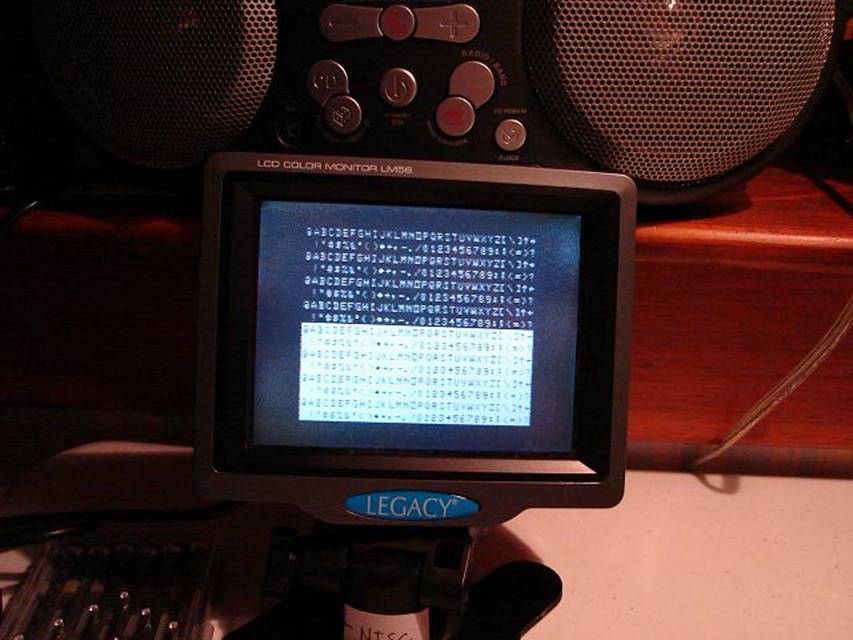
If you are happy with monochrome graphics, the 6847 connected to a monochrome monitor gives an excelent display. The colour modes give a grey-scale image, although in 4 colour modes you only ever get 3 shades of grey since two colours always have the same luminance value. Connecting the colour sub-carrier outputs of the 6847 into the video amplifier through resistors can overcome this, although some playing around with resistor values will be needed to give good results.
The 6847 needs to be synchronised to the CPU to prevent snow on the image. The 6847 needs a 3.579 MHz clock but because its clock input uses an edge detector circuit, there is no way of telling which edge of the clock it is using.
I run the 6502 at half the 6847 clock. The CPU has access to the memory when phase2 is high and the 6847 when phase2 is low. Between the data bus and the 6847 I used a 74HC574 latch which latches the data bus on every rising edge of the phase2 clock. I found that this completely cured the synchronisation problem, allowing me to run programs from the video memory with no snow whatsoever.
The 6561 PAL VIC chip can be removed from a PAL VIC20. Used with a modern 65C02 that has data and address bus enable means you only need a couple of buffers for the data bus. Synchronisation between the CPU and the 6561 is automatic if you feed the CPU clock from the 6561 as the data sheet says. On a PAL TV or monitor, the 6561 can produce a character resolution of 26 x 32 characters - even though the data sheet says the chip can only handle a 700 character screen! The chip can do larger text resolutions but 26 x 32 is the largest that will fit on a TV screen without characters being lost off the edges. There are two versions of this chip and each needs a slightly different video output amplifier. The amplifier circuit I used was a direct copy of the one in the VIC20.
The only problem I have with the 6561 is that it will plonk itself into the memory map at $2000 to $20FF - which sits right in the middle of the RAM area. It is possible to move this by circuit tricks but whatever you do, you will have to ensure that you don't have memory mapped into the same address as the VIC chip.
I used a pair of MC1496 modulators with a 6847 to generate NTSC colour - the design is based on the Acorn Atom colour card. This isn't difficult to do.
If you want PAL it becomes more difficult because you have to keep swapping the phase of the colour sub-carrier. And if you want a 50Hz scan rather than a 60 Hz scan, it becomes very difficult, since you have to stop the clock to the 6847, count clock pulses externally and generate line sync pulses, then restart the 6847 when sufficient extra lines have been scanned. The Acorn Atom board added 25 lines at the top and 25 lines at the bottom of each scan for a total of 50 lines per scan or 100 lines every 2 scans - thus going from 525 lines to 625 lines. It took about a dozen TTL chips to do this and if you want to do this and add colour, you would have to worry about colour bursts as well - this is why I never bothered using the 6847 to generate PAL.
If you are happy with monochrome graphics, the 6847 connected to a monochrome monitor gives an excelent display. The colour modes give a grey-scale image, although in 4 colour modes you only ever get 3 shades of grey since two colours always have the same luminance value. Connecting the colour sub-carrier outputs of the 6847 into the video amplifier through resistors can overcome this, although some playing around with resistor values will be needed to give good results.
The 6847 needs to be synchronised to the CPU to prevent snow on the image. The 6847 needs a 3.579 MHz clock but because its clock input uses an edge detector circuit, there is no way of telling which edge of the clock it is using.
I run the 6502 at half the 6847 clock. The CPU has access to the memory when phase2 is high and the 6847 when phase2 is low. Between the data bus and the 6847 I used a 74HC574 latch which latches the data bus on every rising edge of the phase2 clock. I found that this completely cured the synchronisation problem, allowing me to run programs from the video memory with no snow whatsoever.
The 6561 PAL VIC chip can be removed from a PAL VIC20. Used with a modern 65C02 that has data and address bus enable means you only need a couple of buffers for the data bus. Synchronisation between the CPU and the 6561 is automatic if you feed the CPU clock from the 6561 as the data sheet says. On a PAL TV or monitor, the 6561 can produce a character resolution of 26 x 32 characters - even though the data sheet says the chip can only handle a 700 character screen! The chip can do larger text resolutions but 26 x 32 is the largest that will fit on a TV screen without characters being lost off the edges. There are two versions of this chip and each needs a slightly different video output amplifier. The amplifier circuit I used was a direct copy of the one in the VIC20.
The only problem I have with the 6561 is that it will plonk itself into the memory map at $2000 to $20FF - which sits right in the middle of the RAM area. It is possible to move this by circuit tricks but whatever you do, you will have to ensure that you don't have memory mapped into the same address as the VIC chip.