Page 8 of 14
Re: Functional Test for the NMOS 6502 - request for verifica
Posted: Wed Aug 07, 2013 5:11 pm
by Klaus2m5
The current version of the tests can now also be found on GitHub:
https://github.com/Klaus2m5/6502_65C02_functional_tests
Re: Functional Test for the NMOS 6502 - request for verifica
Posted: Fri Aug 09, 2013 3:41 pm
by MichaelM
Klaus2m5:
Thanks again. After reading your readme.txt file, do you think you could make a your functional test suite available for both Verilog and VHDL cores instead of just VHDL cores?

Re: Functional Test for the NMOS 6502 - request for verifica
Posted: Sun Aug 11, 2013 7:04 pm
by MichaelM
Klaus:
Succeeded in loading the 6502 functional test suite into my simulation environment. It has completed tests through number $29 (41), before it ran out of memory. I've gone back through the thread looking for the total number of tests conducted, and I can find no mention of the number of tests. I expect there to be $2A (42). Can you confirm the total number of tests conducted with this component of the functional test suite? Also, is it possible to jump into test $29? I'd like to avoid using ModelSim for the simulation.
===================================================================================================================
Just to be above board regarding the M65C02 processor core, M65C02_Core.v, and the example soft-processor, M65C02.v, that I'm testing with Klaus' functional tests:
(1) it is not cycle accurate. It can be made that way, but that is for someone else to do. To do so would not require any Verilog source code changes.
(2) it treats subroutine calls and traps in the same manner. This means that JSR, BRK, NMI, and IRQ all require the return address to be incremented
by one on a RTS/RTI in order to point to the instruction. To change this behavior will require Verilog source code changes.
(3) it implements all undefined instructions as single cycle NOPs. It can implement the variable cycle length NOPs, but that is for someone else to do.
Again, it is possible to implement variable cycle NOPs without modifying any Verilog source code.
(4) some instructions are currently uninterruptable. That behavior can also be changed without changing the Verilog source code.
As a consequence of #2 above, I've modified the test suite's test of the BRK return address. I added a minus 1 to the constant in the test suite. Other than that, the M65C02 core and soft-processor have passed all tests as written by Klaus. I wrote an exhaustive test bench simulation for the binary and decimal adder, so I expect that there will be no issues with test numbers $29 and $2A.
Re: Functional Test for the NMOS 6502 - request for verifica
Posted: Sun Aug 11, 2013 7:43 pm
by xeniter
When I look at the trace from your first post it looks as if the PLA gets 0x34 from stack at 01fc, but the compare immediate (0xc9) at 3e67 has 0x30 as the operand to compare to. Something is reversed as you seem to get the correct processor state of the stack, but the compare expects the I flag to be off????? This wouldn't match the listing, that you posted with it!
sorry for that i was such an idiot, i modified your testsuite to test the next error from the t65. But for the mos6510 tests i used the same rom and so it trapped because it worked.
Re: Functional Test for the NMOS 6502 - request for verifica
Posted: Sun Aug 11, 2013 8:08 pm
by Klaus2m5
Hi Michael,
the test numbering is a fairly new feature and is dynamic as one could divide the test into smaller segments if memory is an issue. In the unmodified version the last test is indeed test $2a (ADC & SBC decimal all addressing modes). The purpose of the test numbers is to prevent an unintentional skip of a test and therefore would prevent you from just jumping to test $29.
In order to allow just the last two tests to be executed you need to modify the source and remove all unwanted tests leaving just the last remaining tests to be assembled into an object file. You can accomplish this eather by removing code between the next_test macros including the first macro or by using conditional assembly like:
Code: Select all
      part = 2    ;select which tests to assemble
      ;... test init
   if part = 1
      next_test
      ;... test 1
      next_test
      ;... test 2
      ;... and so on up to test $28
   endif
   if part = 2
      next_test
      ;... original test $29 - now numbered test 1 in part 2
      next_test
      ;... original test $2a - now numbered test 2 in part 2
   endif
      ;... RAM check, subroutines, init data and system vectors.
Regarding NOPs: The test does not count cycles as this would require an external timer. However it does count instruction bytes and in the 65c02 the undefined opcodes are defined NOPs of 1 to 3 bytes length. So the test will fail the NOP test in the 65c02 extended opcodes test.
By the way, Verilog cores are also supported

Re: Functional Test for the NMOS 6502 - request for verifica
Posted: Sun Aug 11, 2013 8:19 pm
by Klaus2m5
Xeniter,
no problem, we all have such moments from time to time. Still I wouldn't call myself or anybody else an idiot for that. It sometimes just needs another pair of eyes...
Re: Functional Test for the NMOS 6502 - request for verifica
Posted: Sun Aug 11, 2013 8:32 pm
by MichaelM
Thanks for confirming the number of tests, and that the binary and decimal mode ALU tests are not dependent on previous results.
Am putting in some conditional assembly around these two tests now. Will likely add your recommendation skip the other tests once they've been completed in an orderly manner.
Re: Functional Test for the NMOS 6502 - request for verifica
Posted: Sun Aug 11, 2013 9:02 pm
by Klaus2m5
Michael,
if you refer to running out of memory as reaching the maximum trace buffer in your simulation environment, changing to just running 1 of the ADC & SBC tests may not be sufficient. These tests are the only ones iterating through all possible combinations of operands, 64k in binary mode, 10k in decimal mode. All other tests run with a small number of predefined operands.
Re: Functional Test for the NMOS 6502 - request for verifica
Posted: Sun Aug 11, 2013 9:24 pm
by MichaelM
Klaus:
Yes, it's an ISim issue. It's never been a terribly well respected product, but I tend to use it because ModelSim is too expensive for the average Xilinx user to purchase. Thus, if I can simulate it with ISim, I am generally comfortable that the design can be supported by others. I've considered looking into VeriWell, Verilator, and Icarus, but just haven't found the time.
It's not my intention to abbreviate the tests. If I can't do them in the simulator, I will have to get a monitor running on my little test board. I prefer running in ISim first, and then on the target hardware. In some ways the simulator environment provides provides more debugging resources on the HW side, but it will run out of memory in those cases where long run times are necessary.
I have found that the decimal mode routines have stopped at the 199 return from the chkdad subroutine. Do you have a suggestion on how to identify the error condition.
Don't want to admit how rusty I am in programming. The adage use it or lose it is definitely true. Had to back track to your original source and start over. Now have a stable source that can be used to generate a binary image from $0000 to $FFFF. It has five small mods.
Code: Select all
zero_page = $a
;        org zero_page
        org 0
        ds  zero_page
Code: Select all
bin_test
    if skip_bin_test = 1
        jmp dec_test
    else
        next_test
    endif
Code: Select all
dec_test
    if skip_dec_test = 1
        jmp success
    else
        next_test
    endif
Code: Select all
; S U C C E S S ************************************************
; -------------
success jmp start       ;if you get here everything went well
; -------------
; S U C C E S S ************************************************
Code: Select all
;        cmp #lo(brk_ret)
        cmp #lo(brk_ret - 1)    ; M65C02 treats JSR and traps (NMI, BRK/IRQ, RST) the same; add one to return address on RTI/RTS
Re: Functional Test for the NMOS 6502 - request for verifica
Posted: Mon Aug 12, 2013 6:23 am
by Klaus2m5
I have found that the decimal mode routines have stopped at the 199 return from the chkdad subroutine. Do you have a suggestion on how to identify the error condition.
If you refer to an expected ADC result of 99 with carry the decimal test most probably stopped at the first run through chkdad. It is counting downwards with both ADC and SBC operands setup to match the expected result. You can find the expected results here:
Code: Select all
0000 =                  zero_page = $0
                        ;add/subtract operand generation and result/flag prediction
0002 : 00               adfc    ds  1               ;carry flag before op
0003 : 00               ad1     ds  1               ;operand 1 - accumulator
0004 : 00               ad2     ds  1               ;operand 2 - memory / immediate
0005 : 00               adrl    ds  1               ;expected result bits 0-7
0006 : 00               adrh    ds  1               ;expected result bit 8 (carry)
0007 : 00               adrf    ds  1               ;expected flags NV0000ZC (-V in decimal mode)
0008 : 00               sb2     ds  1               ;operand 2 complemented for subtract
The actual result is what the accumulator contains when compared to adrl and what the processor status carry bit is by loading it into the accu and comparing it to bit 0 of adrh. The operands to ADC are ad1 (accu), ad2 (memory or immediate) and adfc (carry input). For SBC ad2 is replaced by sb2 (complement of ad2) which in turn should give the same result as ADC. The trap address would point to which opcode failed with which addressing mode and wether it was adrl (expected result) or adrh (expected carry, other flags ignored).
So you need the listing, the content of the registers (PC, accu & carry) and lower zero page memory to identify the error.
Re: Functional Test for the NMOS 6502 - request for verifica
Posted: Mon Aug 12, 2013 9:10 am
by MichaelM
Klaus:
Thanks for the reply. I placed a counter on the RTS from "chkdad". That's how I was able to determine that the test had gone into and returned $C7 (199) times. I will use your variable locations to check for the error conditions.
If I interpret you correctly, each pass through "chkdad" essentially checks 100 operands pairs for all addressing modes of ADC and SBC. The calling test driver sets one (Accumulator) operand and the subroutine sets the other as either immediate or some memory operand..
Unfortunately, I've got work to go to later this morning. It may take a while to mod the testbench to put in the proper memory probes. Thus, it may be a day or so before I can report back on.your recommendations.
Re: Functional Test for the NMOS 6502 - request for verifica
Posted: Mon Aug 12, 2013 10:02 am
by Klaus2m5
Michael,
the calling routine sets both operands, chkdad only checks 1 operand pair plus carry for all addressing modes. So after 199 calls to chkdad (2 calls per decrement with toggling carry) it has decremented ad1 (the accu operand) to 0 and added ad2=$99 + adfc=1 (carry set) (subtracted sb2=0 without borrow) = result adrl=0 with adrh=1 (carry set). 200th entry of chkdad is with ad1=0 ad2=$99 adfc=0 (carry clear) and expects adrl=$99 adrh=$00 (carry clear).
Re: Functional Test for the NMOS 6502 - request for verifica
Posted: Fri Aug 16, 2013 10:17 pm
by MichaelM
Klaus:
Am back on the trail. Unable to spend any time during the week. I have compiled the following table of results for my core using your 6502_Functional_Test.a65 program. For each of the tests that the core has completed, I've noted the execution time. Do you see any times that you would characterize as abnormal/unexpected?
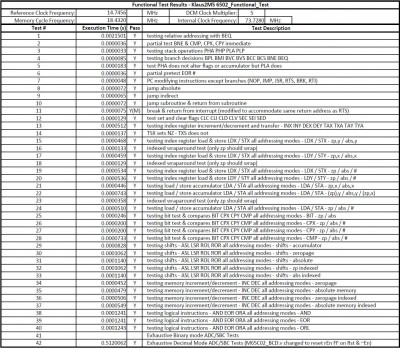
- Results for M65C02 running Klaus2m5 6502_Functional_Test.a65 program. (Updated with decimal mode ADC/SBC results.)
Edited: Figure with the results of the decimal mode ADC/SBC tests.
Re: Functional Test for the NMOS 6502 - request for verifica
Posted: Sat Aug 17, 2013 1:59 am
by MichaelM
Klaus:
I reached that point again in the BCD routine. Tracked the issue down to an error I introduced when I converted all of the ALU multiplexers to gated outputs and an OR gate combiner. I have corrected the error, and the functional test has passed that point. In fact, the simulation has iterated 10,000+ times. If I read your prior post correctly, it appears that a total of 20,000 calls and returns to chkdad() are required to complete this test.
I may skip the binary mode tests for this effort. If the same logic applies to both tests, I would expect that the binary mode check to be called 131,072 times. The decimal mode tests execute on the order of 25.4us/iteration, or ~512ms for the test. The binary mode tests would require about 6x as much time to complete.
I have doubts of being able to use ISim for a simulation of that length. I will likely give it a try, but I am expecting the same "out of memory" error.
I would certainly like to thank you for your 6502 functional tests. The special condition that your test helped identify would have led to some odd errors in decimal mode code. I will have to consider incorporating some of your test techniques into my functional test program that I've been using for regression testing. It certainly did not pick up on the problem your test identified. I will also have to go back a take a look at the ALU and BCD adder test benches. I did not run them again, but relied on my test program for regression testing after I changed the implementation of the bus multiplexers in the M65C02 core.
As I was writing this post, ISim completed the decimal mode test: 0.5120052 s. May let it run the binary mode tests, but it will take several hours to run and I expect it to run out of memory in the process.
Re: Functional Test for the NMOS 6502 - request for verifica
Posted: Sat Aug 17, 2013 7:53 am
by BigEd
Hi Michael
Did you already run Bruce's ADC and SBC tests? It's possible that they take fewer cycles than Klaus' - it would be interesting indeed if they miss some errors which Klaus does not.
See
http://www.6502.org/tutorials/decimal_mode.html#B
Cheers
Ed