Ideas for a faster TTL CPU //6502 related

For discussing the 65xx hardware itself or electronics projects.
User avatar
ttlworks
Posts: 1464
Joined: 09 Nov 2012
Contact:

Re: Ideas for a faster TTL CPU //6502 related

Post by ttlworks »

Aha. Ralf: What tools you had used for stripping the insulation from Teflon wire ?
RalfK wrote:
My first contact to PCs was to a PET 2000.
Elektor Junior computer hobby kit, later CBM 3016 at school, eventually a C64 at home.

Say... if there would be too many rainy days somewhere in the future,
would you be interested to test if a C74 CPU runs with an Apple, or to build a TTL UART ? ;)
RalfK
Posts: 35
Joined: 19 Aug 2017
Location: near Karlsruhe, West-Germany

Re: Ideas for a faster TTL CPU //6502 related

Post by RalfK »

ttlworks wrote:
Aha. Ralf: What tools you had used for stripping the insulation from Teflon wire ?
Hm, I try to remember this details "some" years later: I think I used the soldering iron.
ttlworks wrote:
Say... if there would be too many rainy days somewhere in the future,
would you be interested to test if a C74 CPU runs with an Apple, or to build a TTL UART ? ;)
A C74 CPU? Maybe in autumn (october or so). There are some 65(C)02 based machines :-) But there are also some other interests i.e. a solution based on hardware and software for reverse engineering of PALs and GALs.
Not to forget this interesting software project: https://www.applefritter.com/content/ar ... -processor

Ralf
JimDrew
Posts: 107
Joined: 14 Oct 2012

Re: Ideas for a faster TTL CPU //6502 related

Post by JimDrew »

I looked at doing something similar to what you are proposing, and then I explored the option to use just a fast microcontroller to completely emulate the 6502 itself and that is what I stuck with. It's small, cheap, and works. When running code out of the cache or internally mapped memory I can execute up to 8 instructions in one normal PH2 time (1us). These instructions can be anything from a simple NOP to more complex instructions like LDA ($xx),Y. The great thing is that mapping regions as non-cacheable lets normal peripherals (like a 6522) operate at their normal speed. No having to tweak bus speeds on the fly for peripherals is required.

I am still working on support to be able to switch between 6502 (NMOS) and 65C02 versions. I am also working on similar boards to emulate the Z80 and 6809E CPUs. I made a thread about this here:
viewtopic.php?f=8&t=5562
User avatar
ttlworks
Posts: 1464
Joined: 09 Nov 2012
Contact:

Re: Ideas for a faster TTL CPU //6502 related

Post by ttlworks »

Sorry for the delay.
RalfK wrote:
Not to forget this interesting software project
8231 arithmetic processor for the 6502. Nice.
Any facts on the compatibility between 8231, AM9511 and AM9512 ?

Floating point seems to make M$ Commodore BASIC agonizingly slow, how are things with BASIC on Apples ?

Looking forward to seeing a 68881 or 68882 attached to a 6502... someday...
but info about wat actually happens on the bus between 68008 and 68881\68882 already was hard to get
when these chips were in production.

In theory, one could build a TTL FPU for the 6502, but it would be a lot of work... and a different thread, of course.
We just don't have the _time_ now for spending any thoughts on building something like that.
User avatar
ttlworks
Posts: 1464
Joined: 09 Nov 2012
Contact:

Re: Ideas for a faster TTL CPU //6502 related

Post by ttlworks »

But back on ALU design.

Stumbled over the Onsemi\Fairchild NC7SB3257 2:1 FET bus switch, and to me it looks like a "game changer".
5V capable, 250ps propagation delay through the switch, switch resistance 3 Ohm typ. (Vil) and 6 Ohm typ. (Vih).
alu_switch.png
Left: 1 Bit ALU slice.
Right: ALU slice configurated as an adder.

So if we would be going to use 74AC153 multiplexers as LUs (Logic Units), NC7SB3257 2:1 switches for the carry chain and 74AC86 (or faster XOR gates)
for building our carry skip adder, what would be the min\typ\max propagation delay for the ALU ?
Last edited by ttlworks on Wed Jun 26, 2019 5:54 am, edited 1 time in total.
RalfK
Posts: 35
Joined: 19 Aug 2017
Location: near Karlsruhe, West-Germany

Re: Ideas for a faster TTL CPU //6502 related

Post by RalfK »

ttlworks wrote:
8231 arithmetic processor for the 6502. Nice.
Any facts on the compatibility between 8231, AM9511 and AM9512 ?
i8231 is compatible to AM9511, software and hardware. We bought the Intel chips because they need less power. The AM9512 is different in software and hardware.

I will mainly use the i8231 for 16bit integer multiplication and division within the UCSD p-Machine. The floating point data representation seems to be different to the p-Machines format. I will see ...
ttlworks wrote:
Looking forward to seeing a 68881 or 68882 attached to a 6502... someday...
http://mirrors.apple2.org.za/Apple%20II ... %20Engine/
ttlworks wrote:
but info about wat actually happens on the bus between 68008 and 68881\68882 already was hard to get
when these chips were in production.
Running the 68881/68882 on a 8bit data bus seems to be horrible. These Motorola FPUs were made as compagnion chips to the 68020 coprocessor interface. They use the caches of the CPU and a 32bit data bus.

Regards
Ralf
User avatar
Dr Jefyll
Posts: 3526
Joined: 11 Dec 2009
Location: Ontario, Canada
Contact:

Re: Ideas for a faster TTL CPU //6502 related

Post by Dr Jefyll »

ttlworks wrote:
Left: 1 Bit ALU slice.
Right: ALU slice configurated as an adder.
Great work, Dieter -- very exciting! I agree this could be a game changer (because the use of FET switches minimizes delay in the all-important carry chain).

I don't quite understand the "LU" blocks in the left diagram of your post. But here (below) is a variation on your adder (from the right diagram). It's not any faster, but the chip count is reduced (just two SMD's -- one 6-pin and one 10-pin).

cheers,
Jeff
Attachments
ADDER using SP4T FET switch.png
ADDER using SP4T FET switch.png (3.08 KiB) Viewed 4470 times
In 1988 my 65C02 got six new registers and 44 new full-speed instructions!
https://laughtonelectronics.com/Arcana/ ... mmary.html
User avatar
Drass
Posts: 428
Joined: 18 Oct 2015
Location: Toronto, ON

Re: Ideas for a faster TTL CPU //6502 related

Post by Drass »

I don’t have much to add to the above, except to say WOW! :shock:

Currently, the ALU 8-bit skip-adder is on the critical path:

Code: Select all

ALUA     74AC574    6.0     CLK to Q for input register
ADDER    74AC283   10.6     Lo-byte Adder
SKIP.ADR 74AC257    4.5     Hi-byte Skip Adder
ADR.OUT  74CBT3245  0.25    ALU output select (and latch)
REG.CLK  74AC574    0       Register setup time
Total               21.35ns
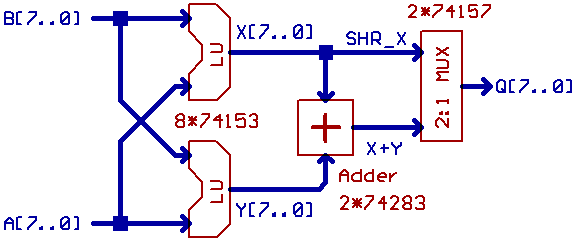
Well, now, it seems that this FET-Switch Adder is going to put the critical path elsewhere. Amazing!

The next longest path is the WriteFlags/BranchTest logic, which sits at 20ns. But it currently includes writing to the P register mid-cycle. It’s possible to bypass the register-write with some additional “flag-select” logic in the branch test. This logic would select flag values coming directly from the ALU for those flags that are being modified in the current cycle (i.e. as a result of an ALU operation in the prior cycle). Any flags not being modified would come from the P register. The Branch decision could then be made in parallel with the P register write, and that saves 6ns. (Is this what you were getting at above Dieter?).
C74-6502 Website: https://c74project.com
User avatar
ttlworks
Posts: 1464
Joined: 09 Nov 2012
Contact:

Re: Ideas for a faster TTL CPU //6502 related

Post by ttlworks »

I think I should elaborate my idea for a different ALU design more detailed.

Drass, what we currently have in the CPU are 74153 4:1 multiplexers,
working as logic units, feeding the inputs of 74283 adders:

Image

;...

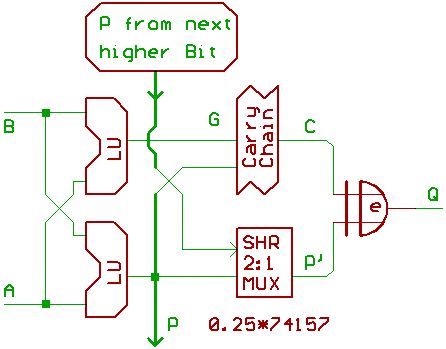
What I'm suggesting is related to the _other_ ALU design described here,
except that the SHR MUX is missing this time.

Image

;---

My suggestion is tossing the 74283 out of the design.

One 74153 contains two 4:1 mutiplexers, which are working as LUs (logic units), emitting the P (propagate) and G (generate) signal for one Bit of data.
(Means, that the ALU control signals for the multiplexers have to be different than they are now.)

The P,G outputs of the two multiplexers per data Bit go to a NC7SB3257 FET switch, 4 FET switches required for 4 Bits of data,
and that's the carry chain.

We need one two input XOR gate per data Bit for generating the ALU output from P and carry, and that's all.

//Maybe tossing the 74283 out of the incrementer\decrementer would make sense, too.

;---

For the two input XOR gate, to me two chips look interesting:
NL17SZ86
NC7SZ86

It's a pity, that there seem to be no XOR gates with three_state output.
User avatar
ttlworks
Posts: 1464
Joined: 09 Nov 2012
Contact:

Re: Ideas for a faster TTL CPU //6502 related

Post by ttlworks »

Ralf, thanks for the link, had not expected to see something like this.

Let's raise the bar: anybody here in the forum who had tinkered with the AM29325 floating point chip ? ;)
And was the heatsink required really as small as in the picture from the data sheet ?
User avatar
Dr Jefyll
Posts: 3526
Joined: 11 Dec 2009
Location: Ontario, Canada
Contact:

Re: Ideas for a faster TTL CPU //6502 related

Post by Dr Jefyll »

ttlworks wrote:
It's a pity, that there seem to be no XOR gates with three_state output.
Dieter, you could consider using 74LVC1G99. It is primarily a 1-bit-wide 2:1 Multiplexer, but its three-state output also has a polarity control. :)
Attachments
1G99.png
1G99.png (1.8 KiB) Viewed 4388 times
In 1988 my 65C02 got six new registers and 44 new full-speed instructions!
https://laughtonelectronics.com/Arcana/ ... mmary.html
User avatar
BigEd
Posts: 11463
Joined: 11 Dec 2008
Location: England
Contact:

Re: Ideas for a faster TTL CPU //6502 related

Post by BigEd »

I think you win the prize there for best 74 series gate.
User avatar
ttlworks
Posts: 1464
Joined: 09 Nov 2012
Contact:

Re: Ideas for a faster TTL CPU //6502 related

Post by ttlworks »

Jeff, thanks for the hint.
74LVC1G99 also could do the SHR functionality of the ALU.

The problem when building the carry chain from NC7SB3257 FET switches is,
because of the switch resistance and the capacitances in the design to me it's hard to judge what would be faster:
Trying to build an 8 Bit carry chain, or to stick with the carry skip adder topology (4 Bit chunks) we currently have in the TTL CPU.

Would suggest to build a test SBC containing just an ALU and a register for both approaches,
then to configurate the ALUs for "increment" and to see which approach would offer more speed.
User avatar
ttlworks
Posts: 1464
Joined: 09 Nov 2012
Contact:

Re: Ideas for a faster TTL CPU //6502 related

Post by ttlworks »

Since the AM29325 was mentioned above, I also took a look at the LVPECL chips.

OnSemi\Fairchild MC100LVEL looks interesting, Microchip\Micrel SY55\SY58 looks interesting, too.

Chips might draw 20..60mA from the power supply, maybe at 5..12€ per chip.
Chips usually contain only one gate, multiplexer or flipflop, and we would be going to need level converter chips too,
so this would take a lot of chips.

IMHO making use of ECL in our CPU _would_ make the CPU a lot faster than memory,
but it will cost too much, draw too much current from the power supply,
and might require something like active (liquid) cooling.

That's like sending the Yamato for sinking a rowboat, in other words: uneconomical.
User avatar
ttlworks
Posts: 1464
Joined: 09 Nov 2012
Contact:

Re: Ideas for a faster TTL CPU //6502 related

Post by ttlworks »

From the datasheet, Microchip\Micrel SY58051 2:1 CML multiplexer is an interesting chip.
If one happens to have all of the signals in inverted and non_inverted form (like when using CML or differential ECL), a 2:1 multiplexer can replace any logic gate.
Edit: at physical layer, it appears that DVI and PCI_express seem to be CML, so it's interesting that there are coventional logic chips in the "CML corner".


Looks like one CML output only can drive one CML input.
But for the other logic families: when building something like a multiplexer or a decoder from something like a tree of 2:1 multiplexers,
the load on the signal lines controlling the multiplexer select inputs usually isn't distributed evenly.

Whygee has written a neat article about creatively stacking 2:1 multiplexers (or SPDT relay switches) in French,
containing some tricks for evenly distributing the load on the control lines.
Post Reply