
I have not breadboarded it to make sure I don't have any errors, but that's what I would start with, then use the oscilloscope to set the programming pulse width. A 28c64 data sheet I found said the width should be 100ns minimum and 1000ms maximum, and the trimmer pot will cover this approximate range nicely. The programming pulse will take place as soon as the button is pressed and held for the debounce period. The debounce period is approximately 1/20 of a second. The address will be incremented right after you take your finger off the button and keep it up for the debounce period (about 1/16 of a second), which will be plenty of time after the programming pulse is finished. The timings will vary from one 74HC14 to another since they do not have a guaranteed hysteresis size. I would recommend the HC14, not the HCT14, because we want the symmetrical input voltages.
How to Start hardware of 2864 EEPROM Self made circuit...??
-
GARTHWILSON

- Forum Moderator
- Posts: 8773
- Joined: 30 Aug 2002
- Location: Southern California
- Contact:
How about something like this:
I have not breadboarded it to make sure I don't have any errors, but that's what I would start with, then use the oscilloscope to set the programming pulse width. A 28c64 data sheet I found said the width should be 100ns minimum and 1000ms maximum, and the trimmer pot will cover this approximate range nicely. The programming pulse will take place as soon as the button is pressed and held for the debounce period. The debounce period is approximately 1/20 of a second. The address will be incremented right after you take your finger off the button and keep it up for the debounce period (about 1/16 of a second), which will be plenty of time after the programming pulse is finished. The timings will vary from one 74HC14 to another since they do not have a guaranteed hysteresis size. I would recommend the HC14, not the HCT14, because we want the symmetrical input voltages.
I have not breadboarded it to make sure I don't have any errors, but that's what I would start with, then use the oscilloscope to set the programming pulse width. A 28c64 data sheet I found said the width should be 100ns minimum and 1000ms maximum, and the trimmer pot will cover this approximate range nicely. The programming pulse will take place as soon as the button is pressed and held for the debounce period. The debounce period is approximately 1/20 of a second. The address will be incremented right after you take your finger off the button and keep it up for the debounce period (about 1/16 of a second), which will be plenty of time after the programming pulse is finished. The timings will vary from one 74HC14 to another since they do not have a guaranteed hysteresis size. I would recommend the HC14, not the HCT14, because we want the symmetrical input voltages.
http://WilsonMinesCo.com/ lots of 6502 resources
The "second front page" is http://wilsonminesco.com/links.html .
What's an additional VIA among friends, anyhow?
The "second front page" is http://wilsonminesco.com/links.html .
What's an additional VIA among friends, anyhow?
OK, today i have implemented the denounce circuit using NAND gate....
it is working well and i have also cascade the 1983 chip but when taking out the carry to the input of counter of 2nd 193 chip it has 1 on its output .....
so when it start add. the 2nd chip shows 1 which should be 0.
I think i need, NOT gate to reverse the direction voltage level or with transistor..
the 2864 chip i am using is here:-
http://www.alldatasheet.com/datasheet-pdf/pdf/105285/CATALYST/CAT28C64A.html
as old EEPROM use 25Volt for programming but how much this will take
Please send the circuit to make EEPROM programmer..!!
Thanks
it is working well and i have also cascade the 1983 chip but when taking out the carry to the input of counter of 2nd 193 chip it has 1 on its output .....
so when it start add. the 2nd chip shows 1 which should be 0.
I think i need, NOT gate to reverse the direction voltage level or with transistor..
the 2864 chip i am using is here:-
http://www.alldatasheet.com/datasheet-pdf/pdf/105285/CATALYST/CAT28C64A.html
as old EEPROM use 25Volt for programming but how much this will take
Please send the circuit to make EEPROM programmer..!!
Thanks
The 2864 is working quiet well i have tested it with my counters and the chip is storing data also....!!
and i want to know is there any limit of time in whichthe write pin should be triggers?? as in data sheet it is mention for nana sec. but here i am using it foe sec......So, please clear this doubt..!!
and i want to know is there any limit of time in whichthe write pin should be triggers?? as in data sheet it is mention for nana sec. but here i am using it foe sec......So, please clear this doubt..!!

RITESH wrote:
Quote:
bootstrapped project.
Cheers
Ed
I have computer i3 .........and other device in it
check this.
http://riteshelectronics.webstarts.com/my_project.html
http://forum.allaboutcircuits.com/showt ... post384786
check this.
http://riteshelectronics.webstarts.com/my_project.html
http://forum.allaboutcircuits.com/showt ... post384786
-
BigDumbDinosaur

- Posts: 9426
- Joined: 28 May 2009
- Location: Midwestern USA (JB Pritzker’s dystopia)
- Contact:
BigEd wrote:
I mean getting started with no infrastructure - no programmer, maybe no computer. It's from the phrase "pulling yourself up by your bootstraps" and of course the computer pioneers had to build things that way. It's more impressive to build a computer if you don't have to use a computer to build it!
Cheers
Ed
Cheers
Ed
 However, I suppose I could have done it the old-fashioned way with perf-board, wirewrap, hand-sketched schematics and a toggle switch program loader. I couldn't imagine at this point in my life sacrificing that much time, especially the part where you convert your assembly language program into a bunch of bits that have to be loaded by hand. Too much like trying to build a locomotive with a hack saw, file and some big wrenches.
x86? We ain't got no x86. We don't NEED no stinking x86!
-
BigDumbDinosaur
- Posts: 9426
- Joined: 28 May 2009
- Location: Midwestern USA (JB Pritzker’s dystopia)
- Contact:
BigEd wrote:
I hear you say "I wouldn't want to do that" but I don't advise the leap to "that's not worth doing." This seems off-topic.
Cheers
Ed
Cheers
Ed
x86? We ain't got no x86. We don't NEED no stinking x86!
-
GARTHWILSON
- Forum Moderator
- Posts: 8773
- Joined: 30 Aug 2002
- Location: Southern California
- Contact:
some related thoughts, although not directly about how to make your own programmer—
What Ritesh has in mind is similar to how I got started in 1985. I had a 6502 class in 1982 but did not try to make anything myself until '85. You can see "Ol' #1" here. I splurged and bought one or two 8Kx8 SRAMs (2764) for it, when they were $40 each at Jameco. This was just before the Japanese started dumping and made the price come way down. Few people had a computer of any kind at home in those days, and EPROM programmers were hundreds of dollars, back when a dollar was a lot more money than it is today. For the previous year, I had been making $7 per hour and on that I paid the apartment rent, the groceries and bills, the expenses for two cars, and put my wife through her last year of college. We were frugal and incurred no debt.
When a person is just starting out, their programs will be small. I wrote programs with pencil and paper, still flowcharted, assembled by hand, and wrote out the machine code on papers to keep in a ring binder, 256 bytes per sheet, on a 16x16 grid. I put in sets of 3 NOPs here and there so if I had to insert some more code I would not have to relocate so much since that was a pain to do by hand. I made my EPROM programmer which used DIP switches. I did not realize yet that DIP switches are not durable enough to handle very many switching cycles, but fortunately my friend who made a lot more money but had no expenses had an HP-71 and had made his own programmer controlled by the 71, and he offered to help. I couldn't justify the money for a UV eraser either, so I left the EPROMs out in the sun for a week. That wasn't too big a deal, because it took so long to debug and patch my code and then schedule a time with my friend who lived several miles away anyway. Thumbwheel switches were expensive, but I should have used those for my own programmer instead of DIP switches. They would have made it a lot more practical. Taking it a step further like Ritesh is doing to make the address auto-incrementing after initializing it would have been even better.
In any case, I would not discourage the beginner from starting at such low levels to get a good feel for the real basics. It seems that too often they're spoiled from the beginning with all the luxuries, and then have problems later on because they never learned the basics. The greater tools are the way to go after learning what the tools' jobs are and what they have to do behind the scenes.
I got the computer going. It wasn't useful but it did work and I learned a lot which I later applied at my next job where we actually had a 40-pound portable PC with an 8" green monitor and two 5.25" floppy-disc drives and, IIRC, 64K of RAM (the only PC in the little company), and a stand-alone assembler we paid $500 for. I don't remember the price of the PC, but the assembler was $250. I think the PC ran DOS 2.0. By then I had learned the HP-71's OS, and learning DOS (even in all the later versions) was a huge let-down, as it was very decrepit compared to the HP-71's system which even had plug-and-play ten years before they started talking about it for PCs.
I have had many frustrations with PCs over the decades though, with things like hard-discs failures and finding that various things are no longer supported when I'd have a problem; so having backup methods of doing everything (hardware too, not just software) does appeal to me. That doesn't mean we have to go back to programming (E)EPROMs by hand for when things really go bad, but I would like to have full control of the entire computer and not be dependent on PCs in the fast-moving consumer market, which is why I have been interested when users here like Samuel Falvo have brought up feasible-sounding proposals of making our own 6502 (or '816, etc.) PC, totally open-sourced in every way, and hobbyist-friendly meaning it does not depend on USB and other things whose internals are not hobbyist-friendly. I know this means we won't have things like streaming video, but that's ok. Sometimes I have thought it would be good to have multiple layers of backup, going down to rather low levels. Every time I finish a project I do make sure I have a paper copy of every single part of it. I think I'm about to buy a used standalone (E)EPROM programmer with RS-232 so it can also be hosted if necessary from a home-made computer without USB, ISA, proprietary software, etc.—or maybe I should just make one.
What Ritesh has in mind is similar to how I got started in 1985. I had a 6502 class in 1982 but did not try to make anything myself until '85. You can see "Ol' #1" here. I splurged and bought one or two 8Kx8 SRAMs (2764) for it, when they were $40 each at Jameco. This was just before the Japanese started dumping and made the price come way down. Few people had a computer of any kind at home in those days, and EPROM programmers were hundreds of dollars, back when a dollar was a lot more money than it is today. For the previous year, I had been making $7 per hour and on that I paid the apartment rent, the groceries and bills, the expenses for two cars, and put my wife through her last year of college. We were frugal and incurred no debt.
When a person is just starting out, their programs will be small. I wrote programs with pencil and paper, still flowcharted, assembled by hand, and wrote out the machine code on papers to keep in a ring binder, 256 bytes per sheet, on a 16x16 grid. I put in sets of 3 NOPs here and there so if I had to insert some more code I would not have to relocate so much since that was a pain to do by hand. I made my EPROM programmer which used DIP switches. I did not realize yet that DIP switches are not durable enough to handle very many switching cycles, but fortunately my friend who made a lot more money but had no expenses had an HP-71 and had made his own programmer controlled by the 71, and he offered to help. I couldn't justify the money for a UV eraser either, so I left the EPROMs out in the sun for a week. That wasn't too big a deal, because it took so long to debug and patch my code and then schedule a time with my friend who lived several miles away anyway. Thumbwheel switches were expensive, but I should have used those for my own programmer instead of DIP switches. They would have made it a lot more practical. Taking it a step further like Ritesh is doing to make the address auto-incrementing after initializing it would have been even better.
In any case, I would not discourage the beginner from starting at such low levels to get a good feel for the real basics. It seems that too often they're spoiled from the beginning with all the luxuries, and then have problems later on because they never learned the basics. The greater tools are the way to go after learning what the tools' jobs are and what they have to do behind the scenes.
I got the computer going. It wasn't useful but it did work and I learned a lot which I later applied at my next job where we actually had a 40-pound portable PC with an 8" green monitor and two 5.25" floppy-disc drives and, IIRC, 64K of RAM (the only PC in the little company), and a stand-alone assembler we paid $500 for. I don't remember the price of the PC, but the assembler was $250. I think the PC ran DOS 2.0. By then I had learned the HP-71's OS, and learning DOS (even in all the later versions) was a huge let-down, as it was very decrepit compared to the HP-71's system which even had plug-and-play ten years before they started talking about it for PCs.
I have had many frustrations with PCs over the decades though, with things like hard-discs failures and finding that various things are no longer supported when I'd have a problem; so having backup methods of doing everything (hardware too, not just software) does appeal to me. That doesn't mean we have to go back to programming (E)EPROMs by hand for when things really go bad, but I would like to have full control of the entire computer and not be dependent on PCs in the fast-moving consumer market, which is why I have been interested when users here like Samuel Falvo have brought up feasible-sounding proposals of making our own 6502 (or '816, etc.) PC, totally open-sourced in every way, and hobbyist-friendly meaning it does not depend on USB and other things whose internals are not hobbyist-friendly. I know this means we won't have things like streaming video, but that's ok. Sometimes I have thought it would be good to have multiple layers of backup, going down to rather low levels. Every time I finish a project I do make sure I have a paper copy of every single part of it. I think I'm about to buy a used standalone (E)EPROM programmer with RS-232 so it can also be hosted if necessary from a home-made computer without USB, ISA, proprietary software, etc.—or maybe I should just make one.
Last edited by GARTHWILSON on Sat Jul 30, 2011 6:19 pm, edited 1 time in total.
http://WilsonMinesCo.com/ lots of 6502 resources
The "second front page" is http://wilsonminesco.com/links.html .
What's an additional VIA among friends, anyhow?
The "second front page" is http://wilsonminesco.com/links.html .
What's an additional VIA among friends, anyhow?
-
GARTHWILSON
- Forum Moderator
- Posts: 8773
- Joined: 30 Aug 2002
- Location: Southern California
- Contact:
Quote:
and i want to know is there any limit of time in whichthe write pin should be triggers?? as in data sheet it is mention for nana sec. but here i am using it foe sec......So, please clear this doubt..!!
http://WilsonMinesCo.com/ lots of 6502 resources
The "second front page" is http://wilsonminesco.com/links.html .
What's an additional VIA among friends, anyhow?
The "second front page" is http://wilsonminesco.com/links.html .
What's an additional VIA among friends, anyhow?
BigEd wrote:
Ah yes, I see! Sorry. But you will be loading your program by toggling the binary in with switches? That seems true to a bootstrapping approach. (Indeed, a 'bootstrap' is a term for the program you have to load manually at power on, if your computer has no other way to boot)
Cheers
Ed
Cheers
Ed
be eg a minimal loader that you toggled in and used to load the actual
loader.
In Ritesh' case maybe toggle in just enough of a program to do the
rest (majority) of the EEPROM programming
(as an aside, I think if I were going to use a counter I'd use the 4040
counter and arrange a fast clock to get it where you want it after reset,
kind of like setting a digital clock)
-
BigDumbDinosaur
- Posts: 9426
- Joined: 28 May 2009
- Location: Midwestern USA (JB Pritzker’s dystopia)
- Contact:
GARTHWILSON wrote:
What Ritesh has in mind is similar to how I got started in 1985...and EPROM programmers were hundreds of dollars, back when a dollar was a lot more money than it is today.
Programming an EPROM this way was slower than a slithering snake in a snowstorm but did the job. The most tedious part was hand-converting the program to the bit patterns that had to be set via the switches. Talk about a mistake-prone task...
A year later, someone published an EPROM burner circuit that worked from the user port on a C-64. A machine language program read in the object code from disk and wrote it to the EPROM burner. It was a lot faster than the toggle switch method, and didn't make mistakes.
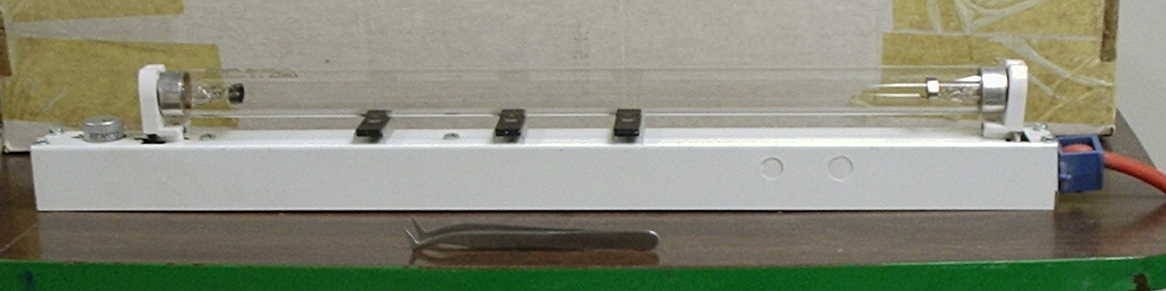
To erase EPROMs I used a UV antiseptic lamp in a kitchen fluorescent fixture, a device I still have (with the same lamp in it). It can erase 12-14 EPROMs in about 15 minutes. Since that picture was taken I have added a timer to it to automatically shut it off. BTW, that's my (very) old dining room table on which the eraser is sitting. When I got married, my wife didn't like my dining room furniture and insisted we replace it. So the table became a work bench.

x86? We ain't got no x86. We don't NEED no stinking x86!